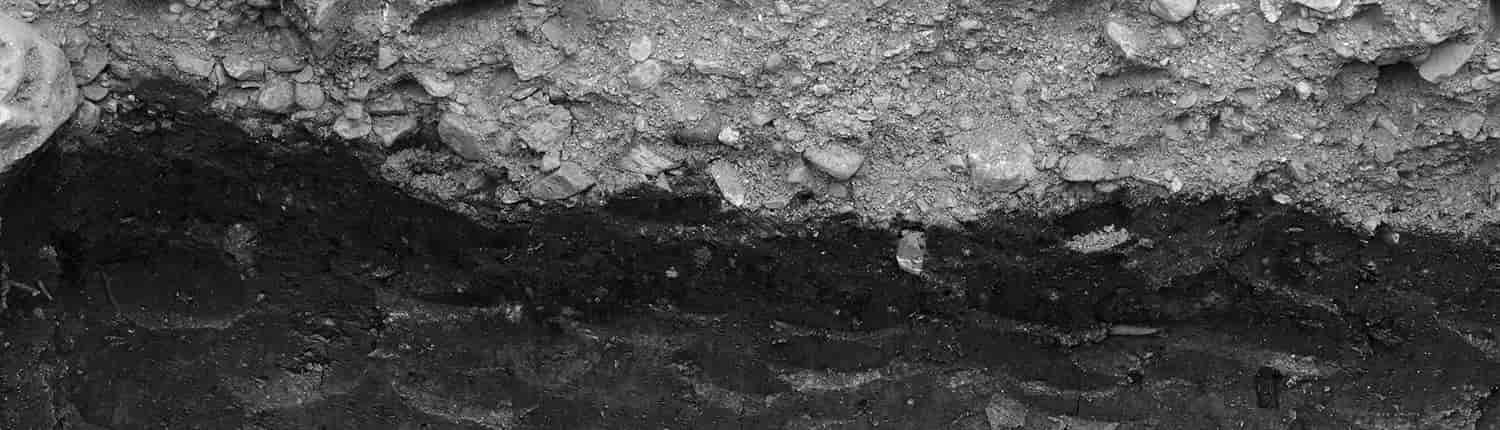
Soil and rock: two different materials
In engineering, the terms soil and rock refer to two very different types of material:
- Rock is a natural aggregate of mineral particles bound by strong cohesive forces. In mass it is a high-strength material, but it can be very weak depending on the joints (fissures) it presents.
- Soil is a natural material made up of mineral particles that can be separated by very low-intensity mechanical means. It is formed, first and foremost, by the erosion of rocks.
Over time, and depending on where they are located, both are altered by very different forces and effects: the pressure of the overlying layers, tectonic forces, temperature, wind or water. That is why even soils or rocks of the same type can have very different internal characteristics, and the calculation theories for each are different.
Why it matters
All structures rest, in one way or another, on soil or rock. Their stability and behaviour depend on the ground lying within the depth reached by the stresses they transmit.
If the strength limits of the ground are exceeded or, even without reaching them, its deformations are significant, secondary stresses appear in the structure that may not have been taken into account in the design: deformations, hairline cracks, cracks, warping or loss of plumb that, in extreme cases, can lead to the collapse of the structure or its abandonment.
What we do
Soil mechanics
- Soil studies.
- Soil characterisation.
- Application of soil mechanics theories.
Rock mechanics
- Rock studies.
- Rock characterisation.
- Application of rock mechanics theories.
The geotechnical survey
The geotechnical survey describes the ground and its physical and chemical properties in order to find the most suitable foundation solution, both technically and economically. It combines in-situ tests on the ground itself with laboratory tests on the samples extracted from the boreholes.
We interpret it with sound judgement: an ‘undisturbed’ sample has undergone changes in moisture and handling, and a generic allowable bearing pressure for the ground can hardly be justified without studying the case. With that data we design the foundation your project needs.